Table of Contents
Technical Protocols & Operational SLA: Stuck Lift Rescue in Hyderabad
Elevator entrapments in high-density urban corridors demand rapid response times, certified mechanical procedures, and strict adherence to safety standards. In Hyderabad—spanning commercial zones like HITEC City, Gachibowli, Financial District, and Kondapur, as well as high-density residential hubs such as Banjara Hills, Jubilee Hills, Kukatpally, Miyapur, Kompally, and Uppal—grid power failures, Automatic Rescue Device (ARD) battery failures, and mechanical brake locks frequently lead to elevator entrapment.
This guide details the technical procedures, safety protocols, statutory compliance requirements, and operational workflows for executing a stuck lift rescue in Hyderabad.
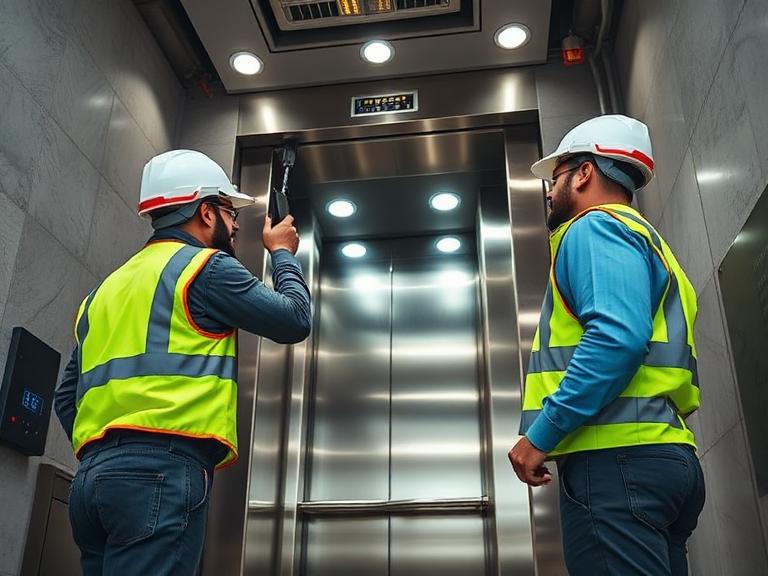
1. Technical Architecture & Entrapment Root Causes
When an elevator stops unexpectedly between floors, the system’s safety chain usually trips. Understanding why the safety chain trips ensures safe passenger extraction without causing further mechanical damage.
                  [ Main Building Grid / Genset Line ]
                                   │
                                   ▼
                   [ Elevator Master Controller ]
                                   │
       ┌───────────────────────────┴───────────────────────────┐
       ▼                                                       ▼
┌──────────────────────────────┐              ┌──────────────────────────────┐
│ Operational Interruptions    │              │ Safety Chain Trips           │
├──────────────────────────────┤              ├──────────────────────────────┤
│ • Grid Voltage Fluctuation   │              │ • Door Interlock Circuit Open│
│ • ARD Battery System Failure │              │ • Governor Overspeed Actuation│
│ • VFD Inverter Overheating   │              │ • Mechanical Safety Jaw Lock │
└──────────────────────────────┘              └──────────────────────────────┘
       │                                                       │
       └───────────────────────────┬───────────────────────────┘
                                   ▼
                   [ Passenger Entrapment Occurs ]
                                   │
                                   ▼
             [ Emergency Dispatch & Technical Intervention ]
Common Technical Failure Modes
- Automatic Rescue Device (ARD) Failure: The ARD is an auxiliary battery system designed to bring the elevator car to the nearest landing during a power failure, open the doors, and park the car. If the battery array degrades, the ARD shuts down mid-transit, leaving passengers trapped between floors.
- Door Safety Loop Interruption: If a landing or car door contact sensor loses electrical continuity due to dirt, mechanical misalignment, or debris in the sill track, the controller cuts power to the drive motor immediately.
- Over-Speed Governor and Safety Jaw Engagement: If the mechanical governor detects downward movement above the rated speed, it trips a cable clutch that drives steel wedges (safety jaws) into the guide rails. This mechanically locks the car frame directly to the rails.
- VFD Drive Thermal Overload: High summer temperatures in machine rooms or top-of-hoistway spaces across Hyderabad can cause Variable Frequency Drives (VFD) to trip on over-temperature protection, immediately setting the mechanical brakes.
2. Technical Comparison: Rescue Protocols by Elevator Type
Different elevator drive architectures require distinct emergency extraction procedures.
| Specification / Mechanism | Geared Traction Elevator | Gearless Machine-Room-Less (MRL) | Hydraulic Lift System |
| Primary Installation Profile | Standard residential apartments (G+4 to G+10) | High-rise residential towers & IT commercial parks | Low-rise luxury villas & private residences |
| Location of Motor/Brake | Overhead Machine Room | Top of hoistway / Guide rail bracket | External hydraulic pump cabinet (Ground/Pit) |
| Manual Drift Method | Hand-released brake lever + manual flywheel winding | Remote Electronic Brake Release (RBR) panel | Manual oil pressure release needle valve |
| Direction of Primary Drift | Drifts toward the lighter side (car vs counterweight) | Controlled by micro-pulses via electronic brake board | Drops downward using gravity flow to lowest landing |
| Primary Rescue Complexity | Moderate (Requires machine room access) | High (Requires top-floor panel interface & battery bypass) | Low (Simple fluid relief valve operation) |
| Average Extraction Time | 15 to 20 Minutes | 15 to 25 Minutes | 10 to 15 Minutes |

3. Step-by-Step Technical Rescue Protocol
All extraction procedures must follow IS 14665 (Indian Standard for Electric Traction Lifts) safety directives and local Telangana Chief Electrical Inspectorate to Government (CEIG) guidelines.
1.Phase 1: Site Isolation & Power Disconnection:Apply Lockout/Tagout (LOTO) Protocols.
- Access the main distribution panel in the machine room or control cabinet.
- Disconnect the primary 3-phase power breaker ($415\text{V AC}$) to prevent sudden power restoration while technicians disengage mechanical components.
- Apply Lockout/Tagout (LOTO) padlocks and warning tags to the main switch.
2.Phase 2: Establish Voice Communication:Reassure Occupants & Confirm Safety Status.
- Establish two-way contact via the cabin intercom or through the landing door gap.
- Inform occupants that the car frame is securely suspended by steel ropes or belts and that passive ventilation is working.
- Instruct passengers to move to the rear of the cabin, keep clear of the doors, and avoid trying to force the doors open from inside.
3.Phase 3: Position Verification & Manual Drift Procedure:Align Elevator Car with the Landing Zone.
- Inspect rope markings or car position indicators to determine the cabin location relative to the nearest floor landing.
- Geared Traction: Attach the manual flywheel to the motor shaft, fit the brake release lever, and pulse the brake open to drift the car slowly toward the nearest floor line.
- Gearless MRL: Operate the Remote Brake Release (RBR) toggle switch at the top-floor controller panel, using battery power to lift the brake shoes in pulses while monitoring the landing-alignment LED indicator.
- Hydraulic: Open the manual lowering needle valve on the hydraulic pump block, allowing oil to return to the tank so the car settles gently to the lower floor.
4.Phase 4: Landing Door Unlocking & Passenger Extraction:Execute Controlled Mechanical Release.
- Verify that the elevator floor is aligned with the landing floor sill to within $\pm 50\text{ mm}$ ($\pm 2\text{ inches}$).
- Insert the specialized mechanical drop key (triangular key) into the landing door keyhole and rotate it to unlock the mechanical interlock.
- Manually pull open the landing door and inner car door together, then help passengers step out safely.
5.Phase 5: Post-Rescue System Isolation & Diagnostic Audit:Keep System Offline Until Inspection.
- Re-close and lock the landing doors securely using the emergency key mechanism.
- Keep the main electrical breaker locked off to prevent unauthorized use of the lift.
- Conduct a full technical audit—inspecting door interlocks, safety switches, ARD battery voltage, and drive fault codes—before restoring power.
4. Diagnostics & Troubleshooting Matrix for Emergency Responders
When an elevator remains immovable during standard manual drift procedures, use the following troubleshooting matrix to diagnose the mechanical or electrical block.
                     [ Field Emergency Diagnostic Flow ]
                                     │
    ┌────────────────────────────────┼────────────────────────────────┐
    ▼                                ▼                                ▼
┌───────────────────────┐┌───────────────────────┐┌───────────────────────┐
│ Mechanical Rail Lock  ││ Brake Release Fail    ││ Door Interlock Lockout│
├───────────────────────┤├───────────────────────┤├───────────────────────┤
│ • Governor tripped    ││ • Dead 24V RBR battery││ • Retractor mechanical│
│ • Safety jaws wedged  ││ • Stuck solenoid arm  ││   binding             │
│ • Counterweight jammed││ • Over-tensioned shoe ││ • Debris in sill track│
└───────────────────────┘└───────────────────────┘└───────────────────────┘
Technical Interventions for Complex Entrapments
- Safety Gear Wedged on Guide Rails:
- Symptom: The motor brake opens, but the elevator car will not drift upward or downward.
- Root Cause: The overspeed governor has engaged the mechanical safety jaws, clamping them directly onto the steel T-rails.
- Solution: Do not attempt downward manual movement. Mount a mechanical chain block or hoisting winch in the overhead space and lift the car frame upward by $50\text{–}100\text{ mm}$ to disengage the safety jaws from the rails.
- RBR Auxiliary Battery Exhaustion (MRL Systems):
- Symptom: The Remote Brake Release switch at the MRL landing panel fails to disengage the brake, and no floor-alignment lights turn on.
- Root Cause: The internal $24\text{V DC}$ emergency battery in the controller cabinet is completely discharged.
- Solution: Connect an external portable $24\text{V DC}$ battery pack directly to the auxiliary brake-release terminals on the controller terminal strip.
- Inter-Floor Door Mechanical Jam:
- Symptom: The car floor is aligned with the landing zone, but the drop key turns without disengaging the outer landing doors.
- Root Cause: The door drive clutch mechanism is mechanically bound against the landing door roller assemblies due to structural shift or debris.
- Solution: Access the top of the car through the landing door above using a secondary drop key, manually release the door drive clutch arm from the car roof, and open the landing door manually.

5. Frequently Asked Questions (FAQs)
1. What should I do immediately if I am trapped inside an elevator in Hyderabad?
Press the yellow Alarm/Help button or use the cabin intercom to alert security staff. You can also call emergency rescue helplines directly. Stay calm, refrain from trying to force the doors open, and wait for certified technicians to arrive.
2. How fast can an emergency lift rescue team arrive at locations in Hyderabad?
Emergency dispatch teams cover major commercial and residential hubs—such as HITEC City, Gachibowli, Financial District, Kondapur, Banjara Hills, and Jubilee Hills—with an average response time of 15 to 30 minutes depending on traffic.
3. Can passengers run out of oxygen inside a trapped elevator car?
No. Elevator cars are designed with mandatory passive air vents around the base and ceiling perimeter. Air flows continuously through the elevator shaft, ensuring adequate oxygen levels inside the cabin.
4. Why do elevators get stuck during power cuts if the building has a generator?
If the building’s Automatic Transfer Switch (ATS) or diesel generator takes 10–30 seconds to start up, the elevator’s controller will trip on power loss. If the Automatic Rescue Device (ARD) fails during this gap, the car stops immediately between floors.
5. Why didn’t the Automatic Rescue Device (ARD) bring the elevator to the nearest floor?
ARD systems rely on dedicated battery arrays. If these batteries are old, unmaintained, or degraded, they cannot deliver enough current to release the motor brake and move the car frame, causing the ARD to fail during a power outage.
6. Is it safe for building security guards to perform an elevator rescue?
Security guards should only perform manual rescues if they have completed certified hands-on training for that specific elevator model. Improper brake release procedures can cause overspeed conditions or drops, risking passenger safety.
7. How does a technician release trapped passengers from a Machine-Room-Less (MRL) lift?
In MRL installations, technicians use a Remote Brake Release (RBR) panel inside the top-floor landing door frame. Using battery power, they pulse the motor brake open to drift the car to the nearest floor landing, then unlock the doors using an emergency drop key.
8. What is a drop key, and how does it open elevator doors?
A drop key (or emergency landing key) is a specialized tool inserted into a small keyhole at the top of the outer landing door. Rotating the key releases the mechanical interlock latch, allowing technicians to slide the outer door open manually.
9. Can an elevator car fall if all electric power fails?
No. Elevators are held by multiple independent steel ropes or polyurethane-coated belts, each rated to support several times the weight of a fully loaded cabin. Additionally, mechanical overspeed governors and safety jaws operate mechanically without needing electrical power.
10. What happens if a lift is trapped between two floors?
Technicians do not pull passengers through a narrow inter-floor opening. First, they manually disengage the motor brake in the machine room or control panel to drift the car up or down until it aligns with a landing floor. Once level, they open the landing doors safely.
11. What is the difference between an emergency extraction service and a routine AMC breakdown call?
A routine AMC breakdown call addresses mechanical repairs and component servicing. An emergency lift rescue service focuses on rapid passenger extraction using dedicated field units equipped for high-priority emergency response.
12. Are hydraulic lifts easier to rescue than traction elevators?
Yes. Hydraulic lifts include a manual lowering valve on the ground-floor pump pack. Opening this valve allows hydraulic oil to flow back into the reservoir, bringing the cabin down to the lowest landing without needing complex winding gear.
13. What precautions prevent lift entrapments during the monsoon season in Hyderabad?
Building managers should inspect pit sump pumps, install surge protectors on main lines, replace aging ARD batteries, and check that machine room louvers prevent rainwater from entering control panels.
14. What statutory certifications govern elevator safety in Telangana?
Elevator installations and safety operations in Telangana fall under the Telangana Lifts, Escalators, and Passenger Conveyors rules overseen by the Chief Electrical Inspectorate to Government (CEIG), requiring regular safety inspections and valid Form-B operating licenses.
15. What should a building management team do after a successful emergency passenger rescue?
Keep the main electrical isolator locked off (LOTO applied), tag the elevator as out of service, and have a certified elevator engineer perform a complete safety audit before returning the system to service.